Giving Credit Where It Isn't Due: How Attribution Models Distort Your Content ROI
Photo: GeneralAB13, CC BY-SA 4.0, via Wikimedia Commons
There is a particular kind of organizational myth that persists in nearly every marketing team: the idea that the content a prospect interacted with just before converting is the content that caused the conversion. This belief, embedded in the logic of last-click attribution, has quietly shaped budget decisions, editorial calendars, and content strategies for years. It is also, in many cases, demonstrably wrong.
Last-click attribution is not inherently malicious. It is a simplification — a practical shortcut that made sense when digital tracking was primitive and multi-touch journeys were harder to reconstruct. The problem is that simplifications calcify into assumptions, and assumptions calcify into strategy. When that happens, marketers end up doubling down on bottom-funnel assets while starving the awareness and mid-funnel content that actually moved the prospect toward a buying decision in the first place.
The Mechanics of Attribution Distortion
To understand why this matters, consider a typical B2B buyer journey. A prospect first encounters your brand through a long-form industry report — let's say a 3,000-word analysis of emerging compliance challenges in their sector. They read it, find it credible, and leave without converting. Three weeks later, they return via a remarketing ad and download a product comparison guide. A week after that, they click a promotional email and request a demo.
Under last-click attribution, the email gets full credit for the conversion. The comparison guide receives nothing. The industry report — the piece that established trust and initiated the relationship — is invisible in your reporting.
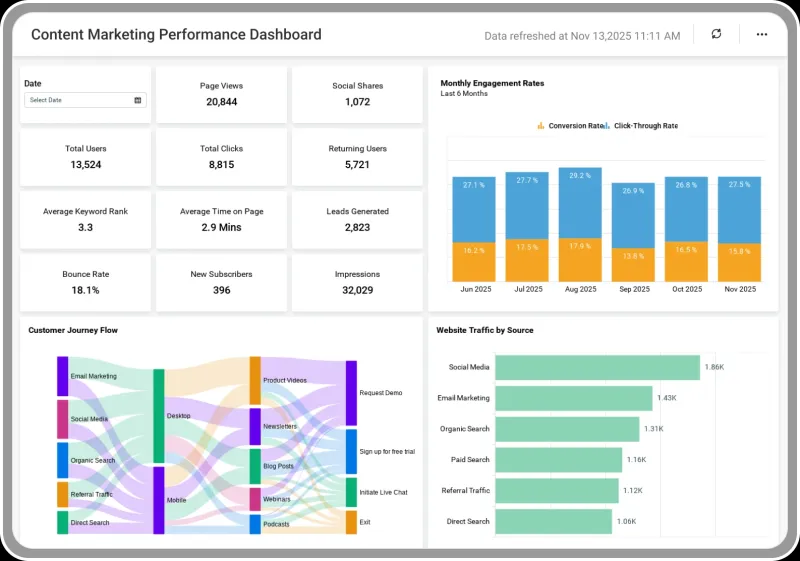
Now multiply this scenario across hundreds of monthly conversions, and you begin to see the structural problem. Your analytics dashboard is presenting a version of reality in which email consistently outperforms content, and in which your top-of-funnel investments appear to generate no measurable return. Budget follows data. Content strategy follows budget. And gradually, the assets that build the most durable conversion pipeline are the ones most likely to be defunded.
Why Mid-Funnel Content Bears the Greatest Cost
Awareness-stage content often benefits from organic discovery and social sharing, which means it has at least some visibility in traffic reports even when attribution models ignore its conversion contribution. Mid-funnel content — the category pages, comparison articles, case studies, and explainer videos that move a qualified prospect toward a decision — tends to be the most invisible.
This content rarely goes viral. It does not drive impressive pageview numbers. It exists specifically to reduce friction for prospects who are already considering a purchase. Because it operates quietly and often through direct or branded search, it is rarely the first touch and almost never the last. Under most standard attribution setups, it effectively does not exist.
The irony is significant. Mid-funnel content typically requires more strategic investment than awareness content precisely because it must address specific objections, speak to buyer intent, and align with the decision-making criteria of a qualified audience. It is expensive to produce and essential to conversion — and yet it is systematically undervalued by the measurement frameworks most organizations use.
A Framework for Attribution That Reflects Actual Contribution
Correcting for attribution distortion does not require abandoning your existing analytics infrastructure. It requires layering more nuanced models on top of your current data.
Position-based attribution distributes credit across multiple touchpoints, typically assigning the largest weights to the first and last interactions while acknowledging the assists in between. This is a meaningful improvement over last-click and is available natively in Google Analytics 4 under its data-driven attribution model.
Time-decay attribution assigns progressively more credit to touchpoints that occurred closer to the conversion event. For longer sales cycles — common in SaaS, professional services, and high-consideration B2C categories — this model can still undervalue early-stage content, but it is considerably more accurate than last-click for mid-funnel assets.
Custom weighted attribution is the most labor-intensive but most precise option. This involves manually assigning credit percentages to content touchpoints based on your understanding of the buyer journey, then validating those weights against cohort conversion data over time. For organizations with sufficient conversion volume and CRM integration, this approach can reveal the true ROI of every content category in your funnel.
Regardless of which model you adopt, the critical step is running a parallel comparison. Before changing any budget allocation, analyze your last 90 days of conversion data under both your current model and at least one alternative. The delta between those two views is where your attribution distortion lives.
Reallocating Budget Based on Contribution, Not Credit
Once you have a clearer picture of which content assets are genuinely influencing conversions — as opposed to simply closing them — the budget reallocation conversation becomes more defensible.
The goal is not to defund bottom-funnel content. Closing content matters. But if your analysis reveals that a category of long-form educational articles consistently appears in the conversion paths of your highest-value customers, that is a data-driven argument for sustained investment in that content type, even if it never shows up as a direct conversion driver in your standard reports.
This is also an argument for restructuring how content performance is reported internally. When leadership only sees last-click conversion data, they are making decisions based on an incomplete ledger. Building a reporting layer that surfaces assisted conversions, path length, and content category contribution gives decision-makers the context they need to support a full-funnel content strategy.
The Competitive Implication
There is a strategic advantage available to any organization willing to invest in attribution accuracy. Most of your competitors are almost certainly making content investment decisions based on last-click or similarly limited models. That means they are systematically underinvesting in the awareness and mid-funnel content that builds durable buyer relationships.
The marketers who understand this dynamic — and who build measurement frameworks that reflect actual contribution rather than final-touch credit — are the ones most likely to develop content programs that compound in value over time. Attribution is not a reporting technicality. It is a competitive lens. And the organizations that correct for its distortions will consistently outperform those that do not.