Stop Obsessing Over the Top of Your Funnel: The Four-Tier Content Strategy That Closes Deals
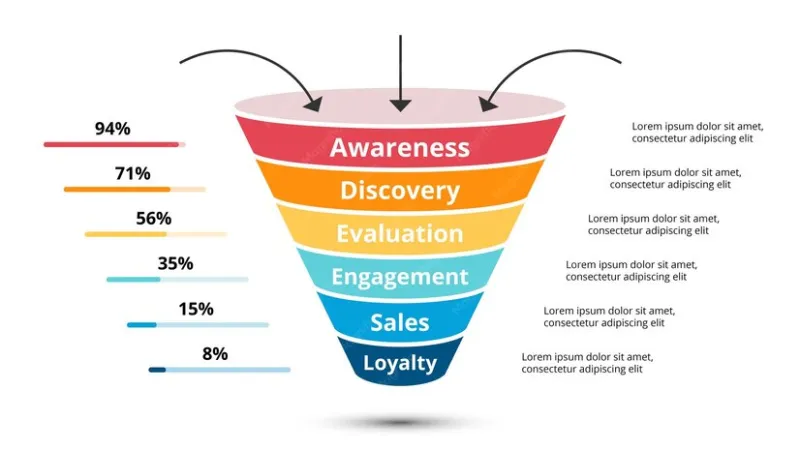
Photo: sales funnel stages content marketing strategy business team whiteboard, via img.freepik.com
The Awareness Obsession Is Costing You Sales
Here is an uncomfortable opinion: the majority of content marketing budgets in the United States are misallocated. Not because the content is low quality—much of it is genuinely excellent—but because it is concentrated almost entirely at the top of the funnel, in a space where attention is cheapest and commitment is lowest.
The cultural fixation on awareness content is understandable. Top-of-funnel content is the most shareable, the most likely to generate flattering engagement metrics, and the easiest to produce at scale. It is also, in isolation, the least likely to produce a customer. Awareness is a prerequisite for conversion, not a substitute for it.
The real conversion battles—the moments when a prospect decides to trust you, to consider your solution seriously, to choose you over a competitor, and to become an advocate who brings others into the funnel—happen in the middle and lower stages. Yet those stages are chronically underserved by content investment. The result is a funnel that fills at the top and leaks everywhere else.
A structured four-tier content hierarchy addresses this imbalance directly.
Tier One: Awareness Content That Does More Than Attract
Awareness content serves a necessary function. It introduces your brand to people who do not yet know they need what you offer. The problem is not the existence of awareness content—it is awareness content that has no path forward.
Effective top-of-funnel content does two things simultaneously: it captures attention and it creates a reason to go deeper. A blog post that ranks for a broad keyword but offers no logical next step is a dead end. The same post, structured with an embedded content upgrade, a contextually relevant internal link to a more specific resource, or a lead magnet aligned with the reader's likely next question, becomes an on-ramp.
When auditing your existing awareness content, ask whether each piece has a deliberate handoff mechanism. If a prospect reads it, finds it valuable, and then leaves your site with no further engagement, the content has done half its job. Restructuring awareness content to include clear, low-friction pathways into the consideration stage is one of the highest-leverage optimizations available to most content teams.
Metric to watch: scroll depth combined with exit rate. High scroll depth paired with high exit rate suggests your content is engaging but failing to create a next step.
Tier Two: Consideration Content That Earns Trust
The consideration stage is where most content strategies go quiet. Prospects in this phase are actively evaluating solutions—they are comparing options, reading reviews, watching product walkthroughs, and forming opinions about which providers understand their specific situation. This is precisely when they most need content, and precisely when most brands stop producing it.
Consideration content takes forms that feel less glamorous than awareness content: detailed comparison guides, use-case specific case studies, webinars that address objections, and FAQ content that answers the questions prospects are too cautious to ask a salesperson directly. In the B2B context, this tier often includes content that helps a buyer build an internal business case—a resource that serves the champion inside an organization who needs to convince colleagues and leadership.
Repurposing awareness content into consideration content is often more efficient than creating from scratch. A broad blog post on industry trends can be restructured into a targeted guide that shows how those trends apply to a specific buyer persona. A general explainer video can be recut into a scenario-specific walkthrough. The core information already exists; the work is in recontextualizing it for a more committed audience.
Metric to watch: time on page and return visit rate. Prospects in the consideration stage tend to spend more time with content and return to it multiple times before making a decision.
Tier Three: Decision Content That Removes Friction
By the time a prospect reaches the decision stage, they are not looking for education—they are looking for permission. Permission to trust you, to justify the investment, to feel confident that choosing your solution is the right call. Decision-stage content exists to provide that permission as efficiently as possible.
This tier includes content that many marketers undervalue: detailed testimonials with specific outcome data, transparent pricing pages, implementation timelines, risk-reduction guarantees, and direct comparisons with alternatives. In the United States market, where consumer skepticism is high and the cost of switching providers is a significant consideration, decision-stage content that directly addresses risk is particularly effective.
One of the most actionable restructuring moves available to content teams is converting existing customer success stories from generic narrative testimonials into outcome-specific case studies. A testimonial that says a customer was satisfied is pleasant. A case study that documents a 34% reduction in customer acquisition cost over a specific time period, with a named company and a verified methodology, is persuasive.
Metric to watch: conversion rate on content-adjacent CTAs. If decision-stage content is working, the conversion rate on demo requests, free trial sign-ups, or consultation bookings that appear near that content should be measurably higher than the site average.
Tier Four: Advocacy Content That Compounds Value
The fourth tier is the one most frequently absent from content strategies, and its absence is expensive. Advocacy content is designed for existing customers—content that helps them succeed with your product, deepens their engagement with your brand, and creates the conditions under which they voluntarily bring new prospects into the top of your funnel.
This tier includes onboarding content, advanced usage guides, community resources, customer education programs, and referral-enabling content that gives satisfied customers a structured way to share their experience. In a business environment where customer acquisition costs continue to rise, the economics of advocacy content are compelling: it serves existing customers while simultaneously generating new pipeline.
The compounding effect is significant. A well-documented customer success story, produced as part of an advocacy content program, can function simultaneously as retention content for the existing customer, social proof for prospects in the consideration stage, and SEO-generating long-form content for the awareness stage. One piece of content, properly positioned, operates across all four tiers.
Metric to watch: referral traffic and net promoter score correlated with content engagement. Customers who regularly engage with post-purchase content tend to have higher retention rates and higher referral rates.
Rebalancing the Investment
Audit your current content inventory against these four tiers. For most organizations, the distribution will reveal a sharp imbalance: an abundance of awareness content, a modest amount of consideration content, minimal decision content, and almost no advocacy content. That imbalance is a map of where your funnel is leaking.
The rebalancing does not require starting over. It requires systematically identifying what already exists, restructuring it for the tier where it is most needed, and filling the genuine gaps with targeted production. The goal is not a perfectly even distribution—awareness content will always constitute a meaningful portion of total output—but a deliberate architecture that guides prospects from first contact to loyal customer without leaving them to navigate the middle stages alone.
A content funnel that is only wide at the top is not a funnel. It is a megaphone. The brands that convert most efficiently are the ones that have built content infrastructure for every stage of the buyer's journey, not just the most visible one.